.png)
.png)

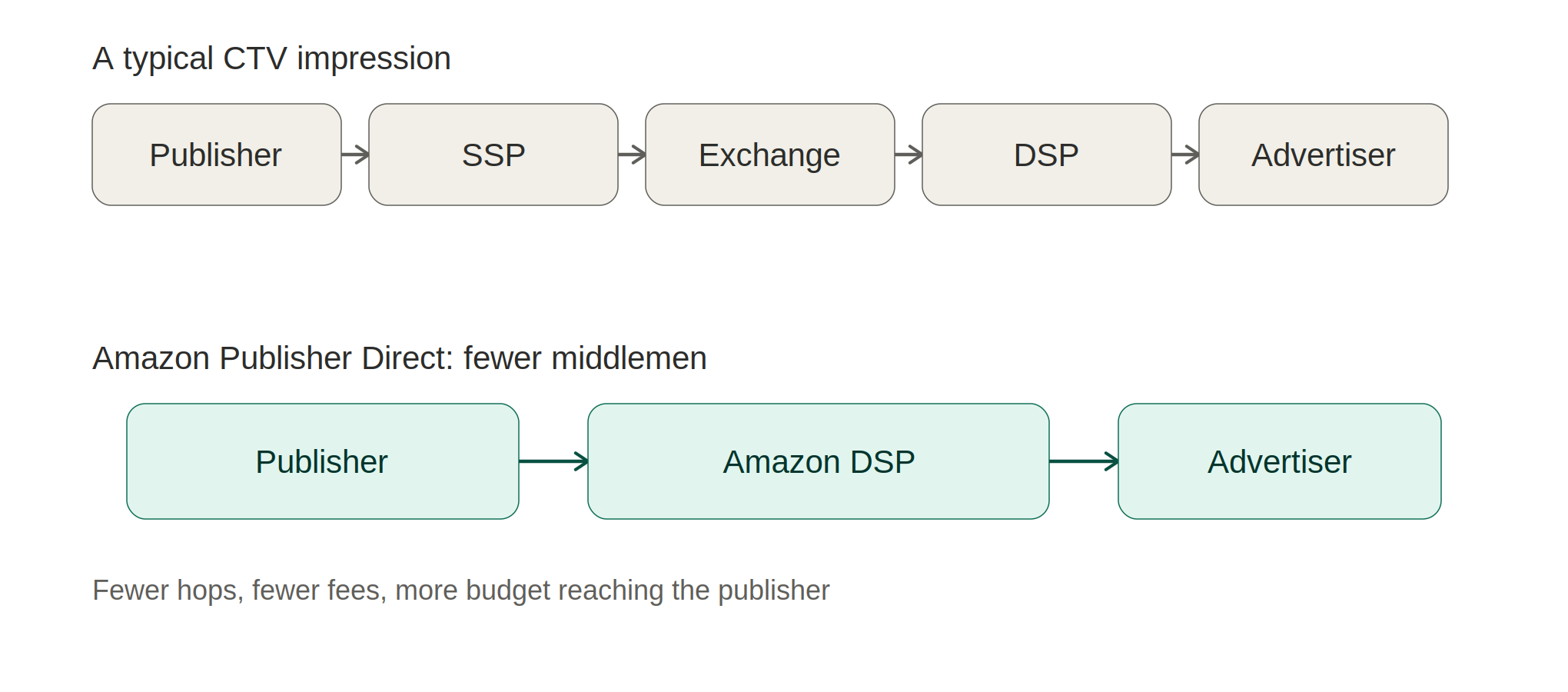
How many companies touch your impression before it reaches the viewer? Every additional platform between the advertiser and the publisher can mean increased fees, latency, and another opening for fraud. Amazon has built one of the more direct supply paths in CTV
For years, CTV buyers have focused almost exclusively on audiences, targeting, and attribution. Those things matter.
But there’s another factor that matters just as much:
How many companies touch your impression before it reaches the viewer?
Every additional platform between the advertiser and the publisher can mean another fee, another auction, another point of latency, and another opening for fraud.
Amazon has built one of the more direct supply paths in CTV through a mix of Amazon-owned inventory, Amazon Publisher Direct (APD), premium private marketplace deals, and curated third-party supply.
The result isn’t just more inventory, it’s better economics.
A typical CTV impression can travel through several intermediaries before it reaches the screen:
Publisher → SSP → Exchange → DSP → Advertiser
Each hop can take a cut of the media spend. The exact amount varies by transaction, but it’s why the industry has spent years talking about Supply Path Optimization (SPO). The more direct the route, the more of your budget actually reaches the publisher.
APD gives advertisers a shorter route:
Amazon APD is direct access to premium publishers, with a dedicated reporting layer showing where ads run* and what’s being paid.
Fewer intermediaries generally means lower tech overhead, less auction duplication, and more predictable pricing.
* Transparency in CTV isn't uniform—it all depends on how the data comes over in the bidstream. One buy might only give you a blind Deal ID, while another hands over the specific genre and exact show name
Premium inventory doesn’t automatically mean a higher CPM. If Amazon removes a technology partner from the chain, the publisher can net more revenue while the advertiser pays a comparable, sometimes lower CPM. Fewer companies are taking a toll on the transaction, not a lower-quality impression.
No platform can promise zero fraud, but fewer hops in the chain generally means fewer chances for domain spoofing, invalid traffic, or duplicate auction paths.
Where legacy programmatic relied on "waterfalling" unsold inventory cascading through exchange after exchange before landing in an open auction.
While today’s CTV ecosystem leans more on unified auctions. Still, the same principle holds.
The closer you buy to the publisher, the less likely the inventory has been resold multiple times already.
Amazon DSP isn’t limited to APD.
The Amazon DSP connects directly to Disney’s Real-Time Ad Exchange (DRAX), giving advertisers streamlined access to Disney+, ESPN, and Hulu inventory. It’s a perfect example of a more direct commercial path to a premium publisher.
Additionally, the Amazon DSP is one of only four programmatic platforms with access to Netflix advertising inventory, giving it a massive edge in premium reach.
Advertisers can also reach premium inventory through integrations with major SSPs like Magnite, FreeWheel, PubMatic, Google Ad Manager, and Roku...via private marketplace (PMP) deals rather than the open exchange. It might be the same premium publisher that runs through APD, but a PMP simply offers an alternative, highly controlled commercial path.
When evaluating CTV inventory, don’t just ask who the publisher is. Ask:
Amazon DSP gives advertisers multiple paths to the same audience from Amazon-owned inventory like Prime Video, to streamlined APD relationships, to premium third-party marketplaces.
For sophisticated buyers, the win isn’t just reaching the right audience. It’s reaching them through the most efficient, transparent path available.
%201.png)
We help agencies and businesses plan, buy, and measure CTV | OTT advertising with full transparency and proven results.
ConnectADtv
4209 Deepwater Lane
Tampa Florida 33615
© 2026 ConnectADtv. All Rights Reserved.
.png)