%201.png)
.png)
.png)

Match back reporting can be a valuable tool. Like every attribution methodology, it has limitations that deserve honest discussion. Use ChatGPT, Gemini, Claude whatever you may use to pull research. Type in what is the overall match rate for a CTV campaign matched back to a customer's first-party sales data. You may be shocked, disappointed, or think to yourself that sounds right. Whatever the outcome it is one that you search out not one that is delivered to you.
Let's Have An Honest Conversation About Match Back Reporting on CTV campaigns.
How accurate is matchback reporting for CTV advertising?
unfortunately, the answer is usually more complicated than the sales pitch.
I don't know exactly what other vendors are saying, I have heard 90 to 95% often. I can state in absloute tersm that is impossible.
I am not asking you to take my word for it. In fact, I encourage you to research this yourself. Use whatever resources you trust, industry research, search engines, or AI tools and ask a simple question:
"What is the overall match rate for a CTV campaign matched back to a customer's first-party sales data?"
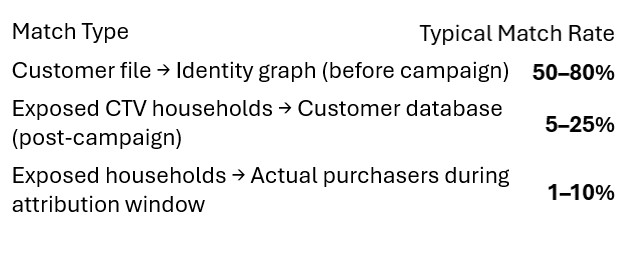
The answer may surprise you. These are the results I received from that query.
Match Type Typical Match Rate
Customer file → Identity graph (before campaign)50–80%
Exposed CTV households → Customer database (post-campaign) 5–25%
Exposed households → Actual purchasers during attribution window1–10%
Matchback reporting can be a valuable tool. Like every attribution methodology, it has limitations that deserve honest discussion.
Some of the biggest challenges include:
• Dynamic IP addresses that change over time.
• Shared networks where multiple people or even entire businesses appear under the same connection.
• Increasing restrictions from premium publishers on device- and content-level exposure data.
• Device manufacturers continue to limit third-party data sharing.
• Multiple attribution vendors independently claiming credit for the same conversion.
None of these challenges mean CTV isn't working.
They simply mean that not every reported conversion is deterministic. Much of today's attribution relies on identity graphs, statistical modeling, and probability, not direct observation. That's an important distinction.
The best measurement strategies don't rely on a single report. They combine multiple signals, View Throughs, Form Fills, website analytics, brand lift studies, and matchback reporting. No single metric tells the entire story.
The goal shouldn't be to produce the biggest attribution number.
The goal should be to give clients the clearest understanding of what's actually happening.
That's how we build confidence.
And that's how we strengthen the future of CTV.
#CTV #ConnectedTV #AdTech #Measurement #MarketingAnalytics #Advertising
We help agencies and businesses plan, buy, and measure CTV | OTT advertising with full transparency and proven results.
ConnectADtv
4209 Deepwater Lane
Tampa Florida 33615
© 2026 ConnectADtv. All Rights Reserved.
.png)