%201.png)
.png)
.png)

Television gives us something a spreadsheet never will: a window into culture. CTV has made that window exponentially bigger.
I have been watching Bewitched Season 1, 1964.
I am also watching Mad Men for the first time. Started in 2007 but covers the same time period.
Something struck me. The two shows are eerily similar. I would have never guessed.
Advertising executives. Smoking everywhere. Cocktails in the middle of the workday. Chauvinistic attitudes toward women that haven't aged well. Even the conversations between agencies and clients sound familiar.
Bewitched was the 1960s. it was a reflection of the time. Nobody was recreating the culture. Nobody was trying to make it historically accurate. Mad Men was created decades later to reconstruct TV circa 1960. I dont remember the 60's but it seems like Madmen nailed it.
We have more audience data than ever: demographics, income, purchase behavior, intent, location, viewing habits.
I use it every day. It's incredibly powerful.
Television gives us something a spreadsheet never will: A window into culture. CTV has made that window exponentially bigger.
The television audience is no longer sitting in front of three networks choosing what to watch at 8:00. Tonight, one household might watch a 60-year-old episode of Bewitched. Another might watch Mad Men. Someone else is watching an NFL game, a new Netflix series... It is all about choice and it is personal.
That fragmentation isn't necessarily a problem. It's information.
The technology has changed completely since Darrin Stephens walked into McMann & Tate.
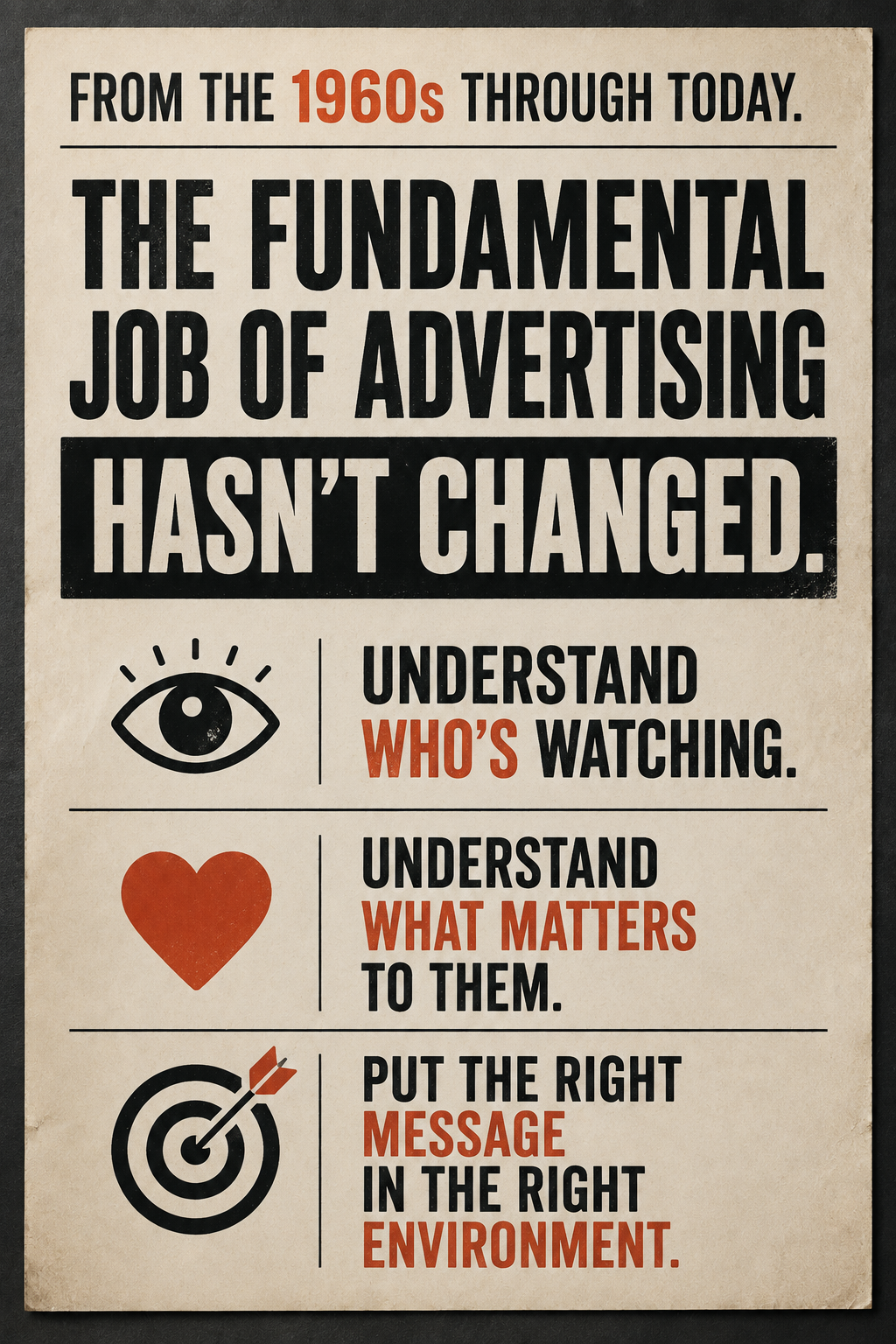
The fundamental job of advertising hasn't.
Understand who's watching.
Understand what matters to them.
Put the right message in the right environment.
CTV simply gives us more signals, more environments, and more opportunities to get it right.
Thankfully, with a lot less smoke in the conference room.
We help agencies and businesses plan, buy, and measure CTV | OTT advertising with full transparency and proven results.
ConnectADtv
4209 Deepwater Lane
Tampa Florida 33615
© 2026 ConnectADtv. All Rights Reserved.
.png)