


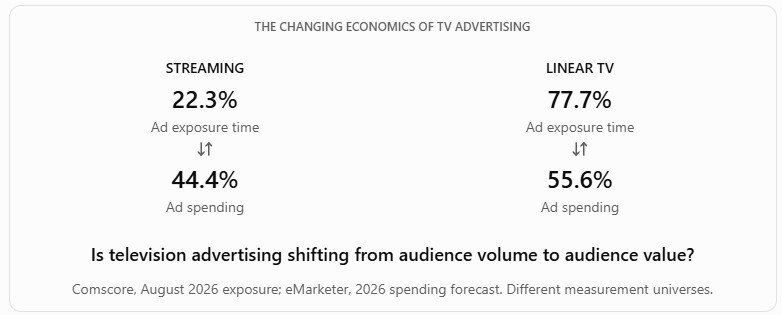
Streaming accounts for just 22% of measured TV advertising exposure, yet CTV is projected to capture 44% of television ad spending. The numbers suggest advertisers are placing a premium on precision, targeting, and accountability.
Last week, I pointed out the widening gap between television viewing and ad exposure:
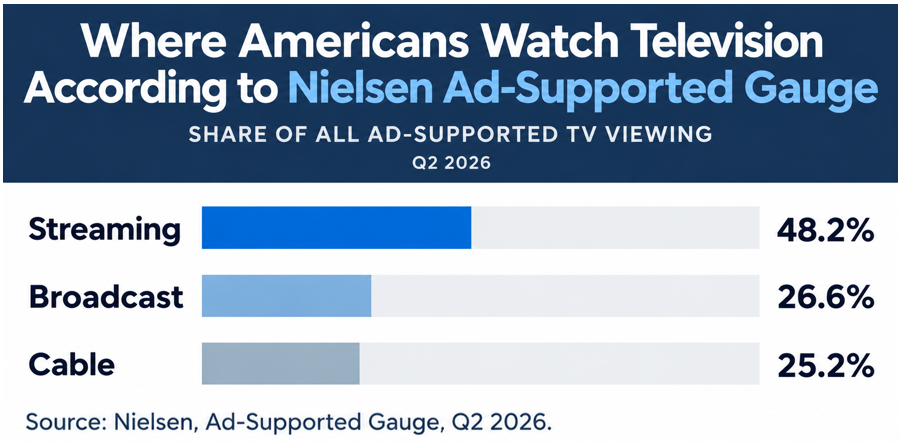
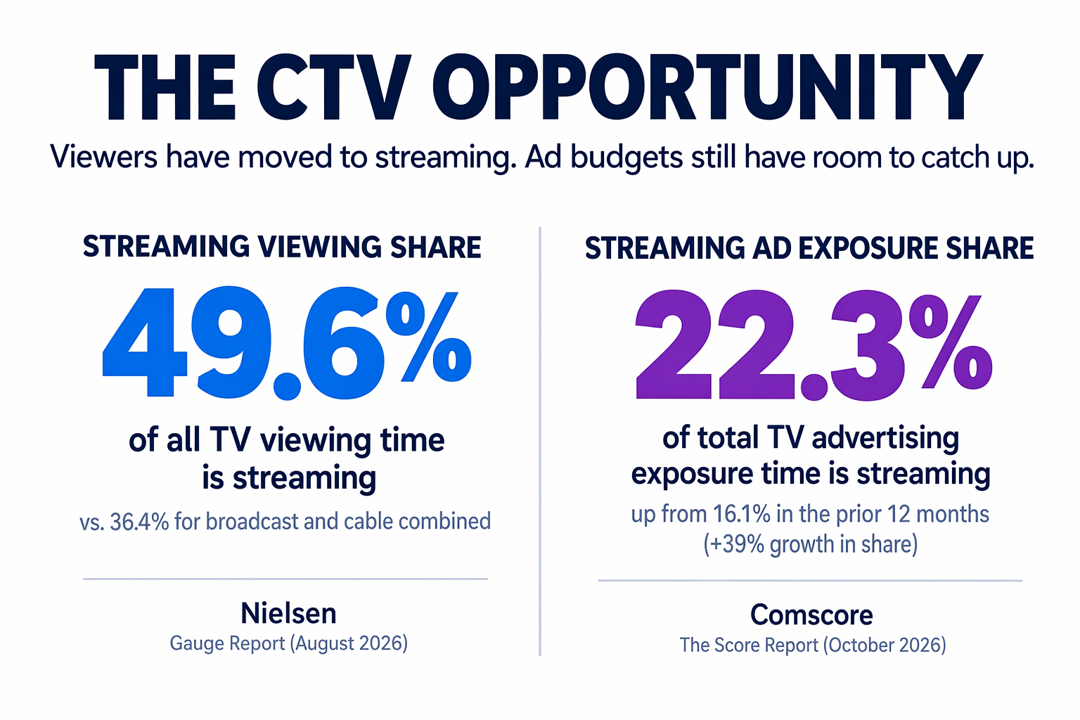
streaming accounts for nearly 50% of TV watch time, but only 22.3% of measured TV ad exposure (Nielsen/Comscore).
Here is where the economics get interesting.
eMarketer forecasts CTV will capture roughly 44% of total combined TV ad spending.
Think about that contrast:
Even across different measurement models, that disparity points to a fundamental shift in how media is valued.
Advertisers and Marketers are willing to pay for CTV’s precision and accountability.
The market is proving that not all impressions are created equal. Advertisers are willing to invest more in streaming because it solves broadcast’s legacy blind spots:
Precise Targeting: Household, intent, and geographicprecision vs. broad market demographics.
Verified Delivery: Impression-based execution and strictfrequency capping vs. program-level averages.
Full-Funnel Attribution: Direct measurement and real-timecampaign optimization.
Higher Share-of-Voice: Lighter ad loads mean fewer competing commercials per pod.
This doesn't mean every streaming spot automatically out-delivers every broadcast unit.
But it does prove that buyers are assigning real dollar value to who they reach, how efficiently they reach them, and what happens after the ad runs.
The future of television advertising isn't just about accumulating raw gross rating points.
It’s about extracting maximum business value from every single impression.
Data Sources: Nielsen Gauge, Comscore Score Report, eMarketer Advertising Forecasts.

We help agencies and businesses plan, buy, and measure CTV | OTT advertising with full transparency and proven results.
ConnectADtv
4209 Deepwater Lane
Tampa Florida 33615
© 2026 ConnectADtv. All Rights Reserved.