.png)
.png)

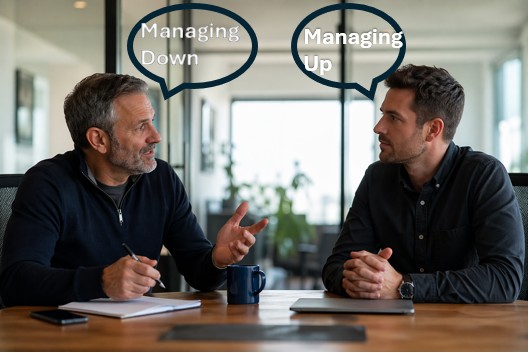
You don’t need a title to lead you need awareness. Managing up and managing down isn’t about hierarchy, it’s about influence. The sooner you learn to support the people above you while empowering the people around (and below) you, the faster you become indispensable.
I recently had a conversation with an early-career professional about the importance of managing up and down.
He was a bit surprised and let me know he was not managing anyone. I simply said, No better time than the present, and if you rethink that statement, you will reap massive benefits.
After the call, I laughed. Despite having some good role models, I was not great at either one of these things for most of my career, so it’s surprising to me that I’ve made it this far.
If the people above you don't understand what you're doing, why it matters, or what you need, you become background noise. Your job is to make their lives easier. Connect your work to revenue, efficiency, and risk. Bring solutions, not problems. (Your manager already has plenty of problems. That's why the door is shut.)
If the people around you, your team, your peers, aren't getting clear direction, don't feel supported, and aren't held accountable, nothing scales. It's not about control. It's about creating an environment where good work becomes the default.
Clear priorities come down from the top.
Translated into an actionable direction
Executed with consistency
Reported back clearly to leadership
Rinse, repeat, and eventually, reset priorities.
When that loop is tight, results compound, and people think you're a natural.
When it's broken, everything feels harder than it should, and you can never quite figure out why.
You don't have to be a manager to start building this. You just have to decide to pay attention in both directions.
Earlier is always better. Trust me on that one.
%201.png)
We help agencies and businesses plan, buy, and measure CTV | OTT advertising with full transparency and proven results.
ConnectADtv
4209 Deepwater Lane
Tampa Florida 33615
© 2026 ConnectADtv. All Rights Reserved.
.png)