%201.png)
.png)
.png)

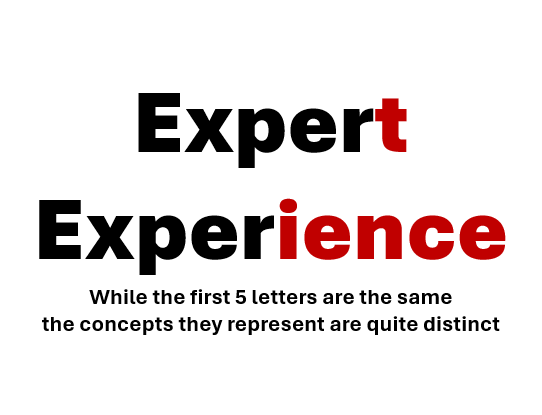
While the words "expert" and "experience" share many letters, the concepts they represent are quite distinct. Experience alone doesn't...
While the words "expert" and "experience" share many letters, the concepts they represent are quite distinct. Experience alone doesn't necessarily equate to expertise. Expertise involves a deep, evolving knowledge base, honed skills, formal and ongoing training, and an ability to adapt and innovate, effective problem solving ...
Experience is the foundation upon which expertise is built, but it's not the whole structure.
Having experience doesn't automatically make someone an expert. In fact, experience can sometimes hinder growth and progress.
Professionals may stagnate, falling into the trap of doing things the way they've always been done. This was evident during my years in broadcast as the industry transitioned to digital. Many of our top account executives resisted the change, mistaking their years of experience for expertise in a field that was rapidly evolving. Some were unable or unwilling to learn the new ways, clinging to outdated methods while the industry moved forward. Conversely, others who had struggled before began to thrive in the new connected world.
We've all heard the saying, "practice makes perfect," but what if you're practicing the wrong thing? Experience, in this sense, can lead to ingrained habits that don't necessarily serve you in a changing environment. Here are some common obstacles that prevent experienced individuals from becoming true experts:
By addressing these obstacles, experienced professionals can transform themselves into true experts, capable of navigating the complexities of their fields and driving innovation.
We help agencies and businesses plan, buy, and measure CTV | OTT advertising with full transparency and proven results.
© 2026 ConnectADtv. All Rights Reserved.
.png)