.png)
.png)

I still believe television has an extraordinary future. I’m just not convinced the traditional television business model does.
Every industry has an inflection point. The question is what happens next.
Industries grow. They mature. Growth slows. And without meaningful innovation, decline often follows.
Look at three once-dominant advertising businesses.
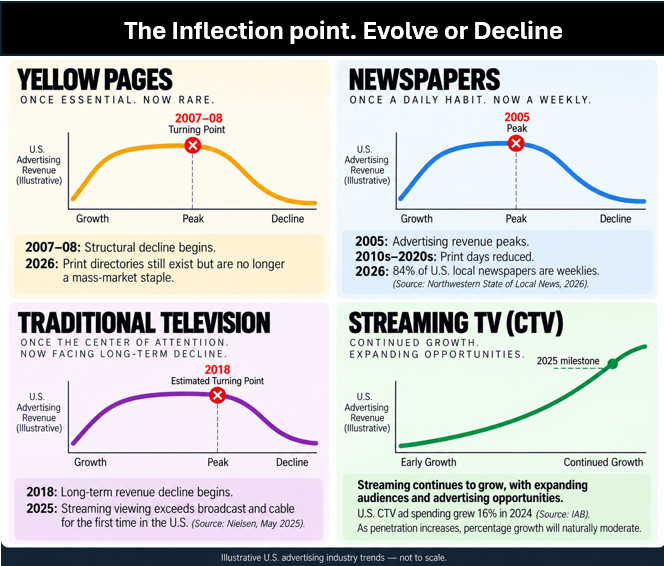
Yellow Pages. The decline accelerated around 2007–2008. Once essential to local businesses, printed directories have largely disappeared from everyday life.
Newspapers. Advertising revenue peaked in 2005. Many newspapers have closed, consolidated, or dramatically reduced their print schedules.
Traditional Television. I put the turning point around 2018. The decline hasn't been a straight line, but the long-term direction is difficult to ignore.
Streaming television tells a very different story.
Audiences and advertising opportunities continue to grow.
Streaming approaches near-universal household penetration, percentage growth will naturally moderate.
Don't mistake slower percentage growth for a shrinking opportunity. A streaming service with 64 million subscribers growing just 4% is still adding more than 2.5 million subscribers.
Here's what I find interesting.
People didn't stop looking for businesses when Yellow Pages declined.
They didn't stop consuming news when newspapers declined.
And they certainly haven't stopped watching television.
What changed was how they consumed it.
Over the past three posts, I've shared my perspective on what's killing local TV.
Cord-cutting, streaming, and changing consumer behavior are real challenges and many post write about them.
What I dont see often and a core belife of mine is that I believe the decisions made inside the industry have accelerated the decline.
Innovation isn't simply finding new products to sell. It's finding ways to make your core product more valuable.
I still believe television has a future.
I'm just not convinced the traditional television business model does.
The question isn't whether television will survive. It's whether the companies that built the industry will successfully evolve with it.
Or has that opportunity already passed?
%201.png)
We help agencies and businesses plan, buy, and measure CTV | OTT advertising with full transparency and proven results.
ConnectADtv
4209 Deepwater Lane
Tampa Florida 33615
© 2026 ConnectADtv. All Rights Reserved.
.png)