%201.png)
.png)
.png)

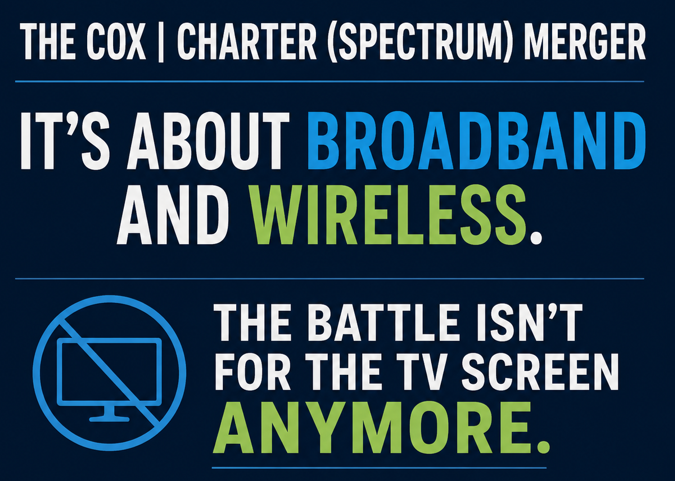
The Cox | Charter | Spectrum merger isn't for the TV screen that has already been lost. It is now about wireless and broadband. two connectivity companies trying to gain scale in a market with a rapidly expanding number of competitors
I have been reading about the Cox | Charter (Spectrum) merger.
Whenever I see a major merger, I always ask the same question:
Why?
If it’s even remotely connected to the industry I work in, I tend to dig a little deeper.
Here’s what I found.
This deal appears to be much more about broadband, wireless and scale than traditional cable TV | video. Charter | Spectrum has been losing broadband and video subscribers. In Q2 2026 alone, Charter lost 172,000 internet subscribers and another 21,000 video subscribers. Meanwhile, Spectrum Mobile added 406,000 lines.
That tells you quite a bit about where the business is going. The competitive landscape has changed dramatically.
Cable companies aren't just competing and losing ground on video. They’re now competing against fiber, Verizon and T-Mobile fixed wireless, AT&T and Starlink for broadband and wireless customers.
Consumers have more choices than ever.
A quick personal example:
While we were living in an Airbnb during the hurricane reconstruction of our home, I used T-Mobile fixed wireless for internet service. I expected it to be a temporary compromise. It was excellent. When we moved back home, I reactivated our fiber service. But if something happened tomorrow and I needed another option, I wouldn’t hesitate to use T-Mobile fixed wireless again. That experience made the changing broadband landscape very real to me.
The Cox | Charter merger makes a lot more sense when you stop seeing it as two cable companies combining and start seeing it as two connectivity companies trying to gain scale in a market with a rapidly expanding number of competitors.
The battle isn't just for the TV screen that has already been lost.
It's for the connection to the home.
We help agencies and businesses plan, buy, and measure CTV | OTT advertising with full transparency and proven results.
ConnectADtv
4209 Deepwater Lane
Tampa Florida 33615
© 2026 ConnectADtv. All Rights Reserved.
.png)